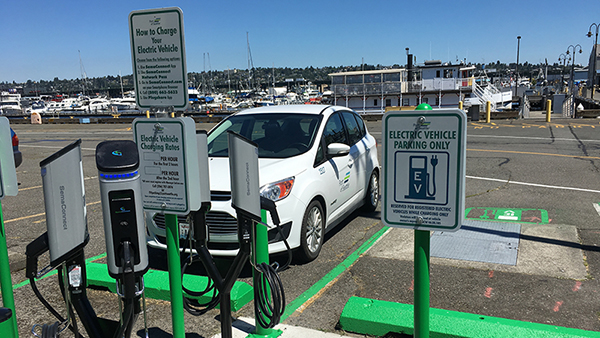
Electrical charging stations located at Fishermen's Terminals.
Issue
Passenger ground transportation to and from Seattle-Tacoma International Airport (SEA) and Port of Seattle maritime terminals contributes to greenhouse gas (GHG) emissions. While SEA has made progress in reducing emissions from taxis and transportation network companies (TNCs), barriers remain to widespread adoption of electric vehicles (EVs), including high vehicle costs, limited access to fast and affordable charging, and regulatory complexities. Maritime terminals lack the data and strategies needed to address similar challenges.
Spark
The Port of Seattle and the University of Washington’s Mobility Innovation Center have partnered to develop equitable guidance that accelerates the transition of taxi and TNC services to electric vehicles. This collaboration supports the Port’s Century Agenda goals to reduce Scope 3 GHG emissions by 50% by 2030 and achieve carbon neutrality by 2050.
Overview
This project will develop policy guidance and infrastructure recommendations to support the transition of taxi and TNC fleets to electric vehicles. It includes stakeholder engagement, barrier analysis, and detailed siting and cost assessments for EV charging infrastructure. The work spans both SEA Airport and maritime terminals, recognizing the unique operational and contractual differences between them.
Innovation
The project combines direct outreach to drivers with quantitative modeling to understand the most effective and equitable strategies for electrification. It will:
-
- Identify barriers such as vehicle cost, charging access, and regulatory constraints.
-
- Evaluate the cost-effectiveness of various incentive programs.
-
- Recommend optimal locations and configurations for EV charging infrastructure.
-
- Collaborate with utility partners to assess power availability and infrastructure needs.
Impact
If implemented, the strategies developed could reduce nearly 30,000 metric tons of carbon emissions annually—over 10% of SEA’s total GHG emissions from passenger ground transportation. The project also supports broader goals of reducing curbside private vehicle mode share, maintaining efficient access to airport facilities, and promoting equitable business opportunities.
Team
Academic Department
Faculty Leadership


Contributors
-
- Alidu Abdul-Razak, PhD Student/Research Assistant
- Rubina Singh, PhD Student/Research Assistant
- Zeyu Wang, PhD Student/Research Assistant
- Bart Treece, Director, Mobility Innovation Center