Issue
Autonomous vehicles (AVs) are rapidly proliferating on city streets, yet cities lack independent tools to observe, document, and evaluate how these vehicles actually behave in dense, multimodal urban environments. Without reliable, infrastructure-based sensing solutions, transportation agencies cannot objectively assess how AVs interact with pedestrians, cyclists, transit riders, and other motorists—leaving critical gaps in public safety oversight, policymaking, and community accountability.
Spark
As AV technology continues to expand in cities across the country, could an innovative sensing solution independently detect, track, and analyze autonomous vehicle behavior in real-world urban conditions— providing the data-driven foundation cities need to make informed, transparent decisions about AV deployment?
Overview
Winner Announced
In August 2026, DDOT named AIWaysion the winner of the AVO Zone Challenge. AIWaysion, partnering with Parsons Corporation, will deploy its Mobile Unit for Sensing Traffic (MUST, a roadside sensing system that uses computer vision to detect and track autonomous vehicles, build detailed trajectory data, and analyze traffic behavior. The pilot is scheduled to begin in January 2027 at the two M Street SE/SW intersections.
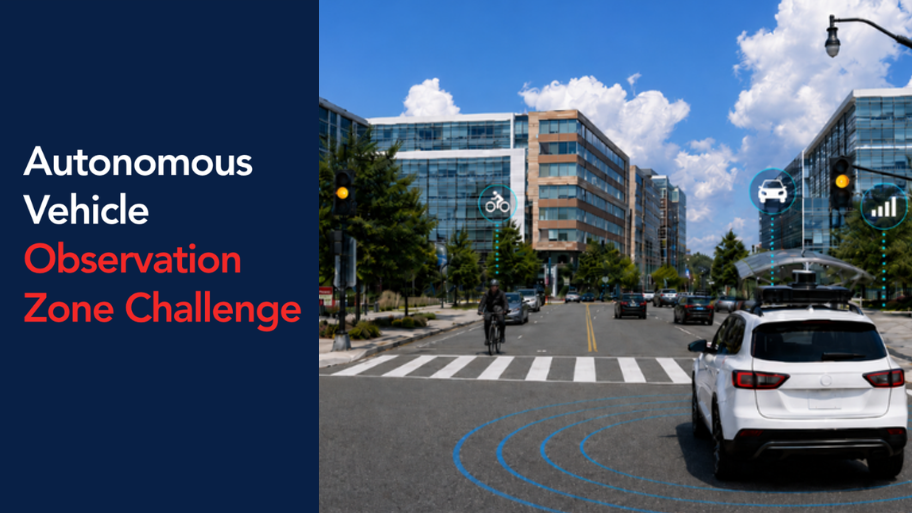
The Autonomous Vehicle Observation (AVO) Zone Challenge, launched by the District Department of Transportation (DDOT), the Southwest Business Improvement District (SWBID), and US Ignite, seeks an innovative sensing solution capable of detecting and identifying AVs operating in Washington, DC, and providing data that supports the observation and analysis of AV fleet operations. The selected vendor will receive a $50,000 contract award and will pilot its technology at two intersections along the M Street SE/SW corridor for three to six months, with deployment expected to begin in early 2027.
The challenge is open to for-profit companies, nonprofits, universities, research institutions, startups, and consortia. Ideal contestants leverage technologies such as CCTV, LiDAR, computer vision, intelligent video analytics, and advanced data processing. Applications are due July 16, 2026, at 5:00 p.m. ET.
Innovation
The AVO Zone Challenge requires sensing solutions that go beyond passive monitoring. The winning technology must independently:
- Detect & Monitor — Identify and track AV activity in real time using infrastructure-mounted sensors, without relying on vehicle transponders or license plate recognition.
- Analyze Interactions — Capture how AVs behave relative to pedestrians, cyclists, buses, and other road users across a variety of traffic conditions.
- Identify Behavioral Patterns — Flag notable or anomalous AV behaviors—such as unexpected stops, lane deviations, or near-miss events—to support safety assessment.
- Provide Actionable Data — Deliver structured, accessible data outputs that transportation agencies can use for reporting, policymaking, and public transparency.
By embedding sensing capability directly into the urban infrastructure—rather than relying on AV operators to self-report—the AVO Zone creates a replicable model for independent public oversight of automated vehicles that any city can adapt and deploy.
Impact
The AVO Zone Challenge positions cities as active, empowered participants in the governance of AV technology—not passive recipients. Its anticipated impacts include:
- Public Safety — Independent, infrastructure-based monitoring fills oversight gaps that currently exist in AV regulations at local, state, and federal levels.
- Equity & Community Trust — Objective data collection enables transparent, community-facing reporting on how AVs operate in neighborhoods and near vulnerable road users.
- Policy Enablement — Findings from the pilot will inform evidence-based AV policy for DDOT and serve as a national model for other cities navigating AV deployment.
- Replicability — The challenge framework and sensing deployment protocol are designed to be scalable and transferable to other urban corridors and municipalities.
- Research Advancement — Data generated through the pilot will support academic research into AV behavior, safety, and multimodal interaction in real-world condition
Team
Faculty Leadership

Xuegang (Jeff) Ban
Research Center
- Intelligent Urban Transportation Systems
- PacTrans
- eScience Institute
Research Areas
- Transportation Engineering
- Transportation Network System Modeling & Simulation
- Urban Traffic System Modeling and Operations
- Intelligent Transportation Systems
- Connected / Automated Vehicles
- Transportation Big Data Analytics
Contributors
- Bart Treece, Director, Mobility Innovation Center, University of Washington
Partners