Issue
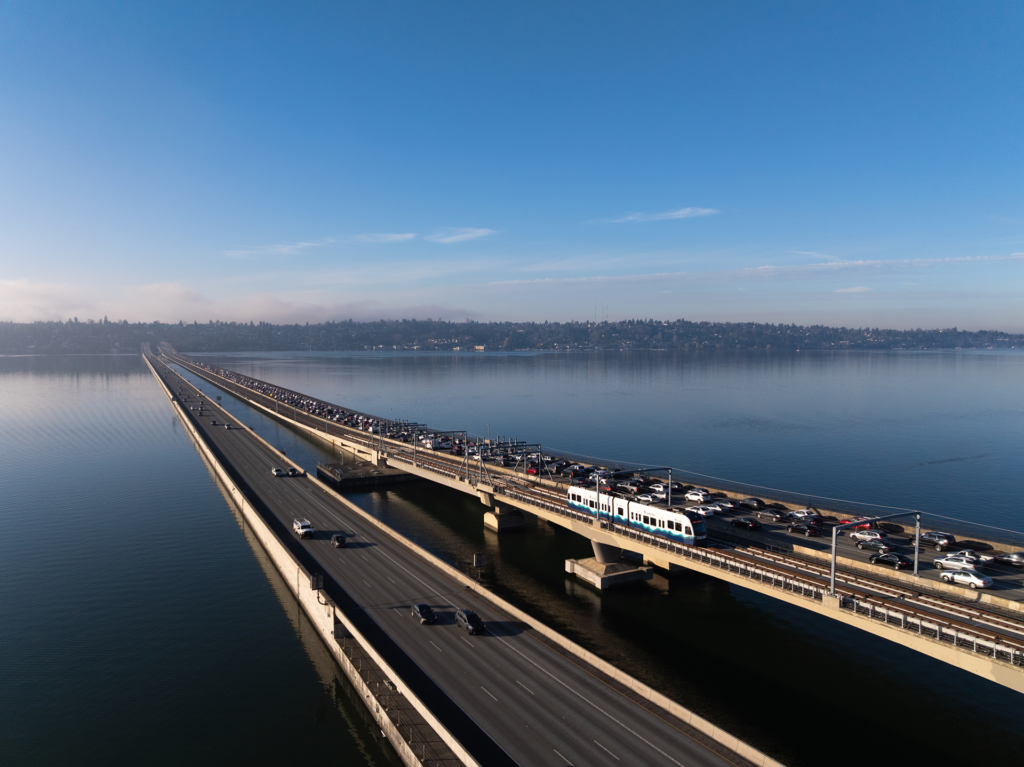
Maintaining and preserving complex critical infrastructure is essential to maximize public investment. Typically, bridge maintenance and repair decisions are typically informed by visual inspection, a method that depends heavily on inspector judgment and experience. This approach carries inherent risk: agencies may undertake unnecessary early repairs that consume limited resources, or fail to detect developing issues until they require emergency intervention. These risks are particularly relevant for the I-90 Homer Hadley floating bridge, which now supports Sound Transit’s Link light rail service in addition to standard vehicle traffic, a demand the 37-year-old structure was not originally designed to accommodate. The bridge’s unique behavior as a floating structure, including its sensitivity to anchor cable tension, lake level changes, and weather, adds further complexity to assessing its long-term condition.
Spark
Could a real-time digital twin, built from integrated sensor data across multiple systems, give agencies the insight needed to identify and address structural wear before it becomes a safety or maintenance concern?
This project, Phase 2 of the I-90 Homer Hadley digital twin initiative, integrates Sound Transit’s track and train sensor data into a digital twin model of the bridge, building on the sensor infrastructure established in Phase 1. The project includes the following research tasks:
• Provide Sound Transit and WSDOT personnel for access and training on the digital twin, ensuring best practices for data sharing, cybersecurity, and privacy
• Identify existing data streams and evaluate additional monitoring needs with agency partners; co-create an equipment list for possible new sensor deployment
• Coordinate with WSDOT and Sound Transit on the use of digital twin technology for tactical and strategic asset management
• Refine the existing data architecture to combine agency data streams within the digital twin
• Evaluate Sound Transit and WSDOT’s future needs for predictive analysis, integrating new or existing numerical simulation tools
• Conduct LiDAR scans (drone or train-mounted) of the bridge and track bridge for integration into the digital twin
• Develop alerts and visualizations in coordination with engineers and maintenance crews
• Coordinate with key agency staff through regular and monthly standing meetings
• Take spot measurements of track bridge bearings and OCS expansion joint displacement to evaluate the accuracy of the digital twin’s predictions
• Identify potential off-ramps for data and digital assets for adoption or decommissioning
• Deliver a final report with findings and recommendations for Phase 3 development
• Deliver a workshop for agency personnel on findings from the first two phases
Innovation
This phase advances the first of its kind digital twin application for operations, maintenance, and asset management by integrating sensor data across multiple systems and agencies into a single operational model of the bridge. This approach requires reconciling data from disparate sources, including transit operations equipment, structural sensors, and new LiDAR scans, into a coherent framework capable of supporting maintenance and operational decisions.
Impact
This project is expected to provide Sound Transit and WSDOT with earlier, more accurate insight into the condition of critical bridge components, reducing reliance on fixed-interval inspections and supporting more informed maintenance and recalibration decisions. It also establishes a shared operational framework between the two agencies responsible for different aspects of the same structure, improving coordination on joint operations and long-term asset management. Findings from this could potentially extend the digital twin’s capabilities from condition monitoring toward predictive analytics, ultimately supporting the bridge’s ability to meet or exceed its 75-year design lifespan.
Team
This work is supported by Sound Transit, with in-kind contributions from industry partners.
Academic Department
Contributors
Principle Investigator
- Travis Thonstad, UW Department of Civil and Environmental Engineering
- Michael Motley, UW Department of Civil and Environmental Engineering
- Amos Darko, Construction Management
- Carrie Sturts Dossick, Construction Management
- Bart Treece, Director, Mobility Innovation Center
Graduate Research Assistant
- Ori Borjigin
- Noemi Koenig
- David Morales Obando
- Brigitte Young
- Mason Stevenson
Partners